
Dumble guys, I'd like to hear your thoughts on the power amp section.
My experience with Dumble-style amps is pretty limited.
I was used to play a Two-Rock 50W quite a few years ago, and I still remember it, but that's about the extent of my direct first-hand experience.
I'd like to get a better understanding of what really makes the power amp section work in a Dumble-style amp, so I'd be interested to hear from those of you who've spent more time playing these amps.
I'm not just asking about the usual specs, tube choices or output power.
I'm more interested in what you feel the power amp actually contributes to the overall feel and response.
For example, how much of the character comes from the output stage itself, its operating point and the power supply?
How important are the feedback arrangements, and what do you consider essential for getting that particular combination of touch sensitivity, dynamics, sustain and clean-to-overdrive transition?
I know there are different Dumble circuits and plenty of variations, so I'm not expecting one universal answer.
That's actually what makes the subject interesting.
If you've owned, played or built a few of these amps, I'd really appreciate hearing what you've found in practice.
Not looking for secret recipes, just trying to separate what really matters from what we tend to take for granted.
Thanks!
Roberto
Dumble Push-Pull power amps: what really matters?
Moderators: pompeiisneaks, Colossal
-
martin manning

- Posts: 14936
- Joined: Sun Jul 06, 2008 12:43 am
- Location: 39°06' N 84°30' W
3 others liked this
Re: Dumble Push-Pull power amps: what really matters?
The short answer is it's a clean power amp, with a bit more reservoir capacitance than the Fender designs from which it came. Nearly all of the distortion is generated in the preamp.

Re: Dumble Push-Pull power amps: what really matters?
Getting the negative feedback on the speaker output coming from the phase inverter is important too. I would make it a 10KL variable pot at first and then adjust it as you play to find your sweet spot. Its amazing how much this can change the tone of the amp.
This can also effect the cleanness of your power amp.
Cheers
Guy
This can also effect the cleanness of your power amp.
Cheers
Guy
Last edited by Guy77 on Fri Oct 09, 2026 4:18 pm, edited 1 time in total.
Re: Dumble Push-Pull power amps: what really matters?
Thanks martin!
That was what I got from the Two Rock while playing at it and from the feedback of some builders specialized in this kind of amp.
It's good to read same information confirmed here.
The concept of the reservoir is another details I've been pointed to.
The poweramp needs to let the preamp breath without controlling its dynamic.
I have to say that those 50 W were absolutely fine with me with the band, so my choice would be to stay around 60-80 Wrms.
A flattish load line and local linearization of the poweramp like with the single ended version would be the starting point I would like to develop.
Is there anyone that played with the poweramp on this forum?
I haven't found anything.
That was what I got from the Two Rock while playing at it and from the feedback of some builders specialized in this kind of amp.
It's good to read same information confirmed here.
The concept of the reservoir is another details I've been pointed to.
The poweramp needs to let the preamp breath without controlling its dynamic.
I have to say that those 50 W were absolutely fine with me with the band, so my choice would be to stay around 60-80 Wrms.
A flattish load line and local linearization of the poweramp like with the single ended version would be the starting point I would like to develop.
Is there anyone that played with the poweramp on this forum?
I haven't found anything.
Re: Dumble Push-Pull power amps: what really matters?
Thanks Guy!
It's usually a balance of how stiff the amp can be vs how dull it becomes if there's too much gnfb.
That's why I would like to try some of the tricks I've used on the SE for the PP too.
Trying to get more benefits without too much drawbacks of the standard configuration.
I will for sure use the pot to set the feedback, then fix it with the closest value.
It's usually a balance of how stiff the amp can be vs how dull it becomes if there's too much gnfb.
That's why I would like to try some of the tricks I've used on the SE for the PP too.
Trying to get more benefits without too much drawbacks of the standard configuration.
I will for sure use the pot to set the feedback, then fix it with the closest value.
-
martin manning
- Posts: 14936
- Joined: Sun Jul 06, 2008 12:43 am
- Location: 39°06' N 84°30' W
2 others liked this
Re: Dumble Push-Pull power amps: what really matters?
Comparing the GNFB network in the typical Dumble 4k7/390 (7.7%), and a 12AX7 PI, to the Fender Twin Reverb which uses 820/100 (10.9%) and a 12AT7, the Twin has lower open loop gain and more feedback.
Re: Dumble Push-Pull power amps: what really matters?
Thanks martin, has anyone measured the Zout of those amps? Or at least estimated?
-
martin manning
- Posts: 14936
- Joined: Sun Jul 06, 2008 12:43 am
- Location: 39°06' N 84°30' W
1 others liked this
Re: Dumble Push-Pull power amps: what really matters?
Not that I am aware of.
-
Fischerman
- Posts: 912
- Joined: Thu Dec 07, 2006 3:47 pm
- Location: Georgia
1 others liked this
Re: Dumble Push-Pull power amps: what really matters?
What about the standard Dumble PI vs the Bluesmaster (i.e. Marshall PI if I've got the terminology right)? What is the difference in drive level and bandwidth?
Early brewers were primarily women, mostly because it was deemed a woman's job. Mesopotamian men, of some 3,800 years ago, were obviously complete assclowns and had yet to realize the pleasure of brewing beer.
Re: Dumble Push-Pull power amps: what really matters?
Consider the power amp and choice of speaker, EV12L, which is capable of high power and sound pressure levels without a lot of cone break up.
It appears the philosophy was to keep the power amp and speaker quite clean, with most of the amp's character coming from the preamp stages.
It is interesting doing a deep dive on phase inverters, both in Fender's history and the conversion from tweed/brown era 12AX7 to 12AT7 in the black and silver face era,and their operating points and what they did later in the "Blues Deluxe/junior" etc, feed back loops, and so on, and what Dumble chose to do. I've done some analysis of the circuits and it seems like more of a rabbit hole than it is a definitive direction.
It appears the philosophy was to keep the power amp and speaker quite clean, with most of the amp's character coming from the preamp stages.
It is interesting doing a deep dive on phase inverters, both in Fender's history and the conversion from tweed/brown era 12AX7 to 12AT7 in the black and silver face era,and their operating points and what they did later in the "Blues Deluxe/junior" etc, feed back loops, and so on, and what Dumble chose to do. I've done some analysis of the circuits and it seems like more of a rabbit hole than it is a definitive direction.
Re: Dumble Push-Pull power amps: what really matters?
I don’t have a Dumble, of course, and the Two Rock is gone years ago, so I can only similate to have an idea of it (not 100% correct, but at least in the ballpark).
Can you please confirm B+ around 460V, Raa 2k2 for the 4x 6L6GC, bias around 70% of plate dissipation, feedback taken from the 8 Ohm tap? 100 Ohm primary and 0,4 Ohm secondary Rdc.
Any preference about the presence control?
Re: Dumble Push-Pull power amps: what really matters?
Can you give me a reference link of the two specific schematics you want to be compared?
As for the bandwidth, generally the high Zout of the amp makes the speaker and cabinet control it in a good percentage. Coupling cap, presence control and output transformer specifications (again because of the high impedance of the pentodes driving it) do the rest. Then the nfb tries to extend the bandwidth, reduce the distortion and have more control on the speaker.
Re: Dumble Push-Pull power amps: what really matters?
So towards hi-fi land, without going that far. The experience I did on LPTI and power amps in that field can come handy, as with the SE version.
I would like to try two approaches, one with 12ax7 and one with ecc88 or similar (so andriver with more or less capanility to drive the output tubes).
Has anyone ever tried different load lines (even simply by mismatching a 16 Ohm cab in a 8 Ohm output, with or without modifying the nfb)?
Thanks,
Roberto
-
Fischerman
- Posts: 912
- Joined: Thu Dec 07, 2006 3:47 pm
- Location: Georgia
1 others liked this
Re: Dumble Push-Pull power amps: what really matters?
Here's a couple of layouts.roberto wrote: ↑Sun Oct 11, 2026 8:07 amCan you give me a reference link of the two specific schematics you want to be compared?
As for the bandwidth, generally the high Zout of the amp makes the speaker and cabinet control it in a good percentage. Coupling cap, presence control and output transformer specifications (again because of the high impedance of the pentodes driving it) do the rest. Then the nfb tries to extend the bandwidth, reduce the distortion and have more control on the speaker.
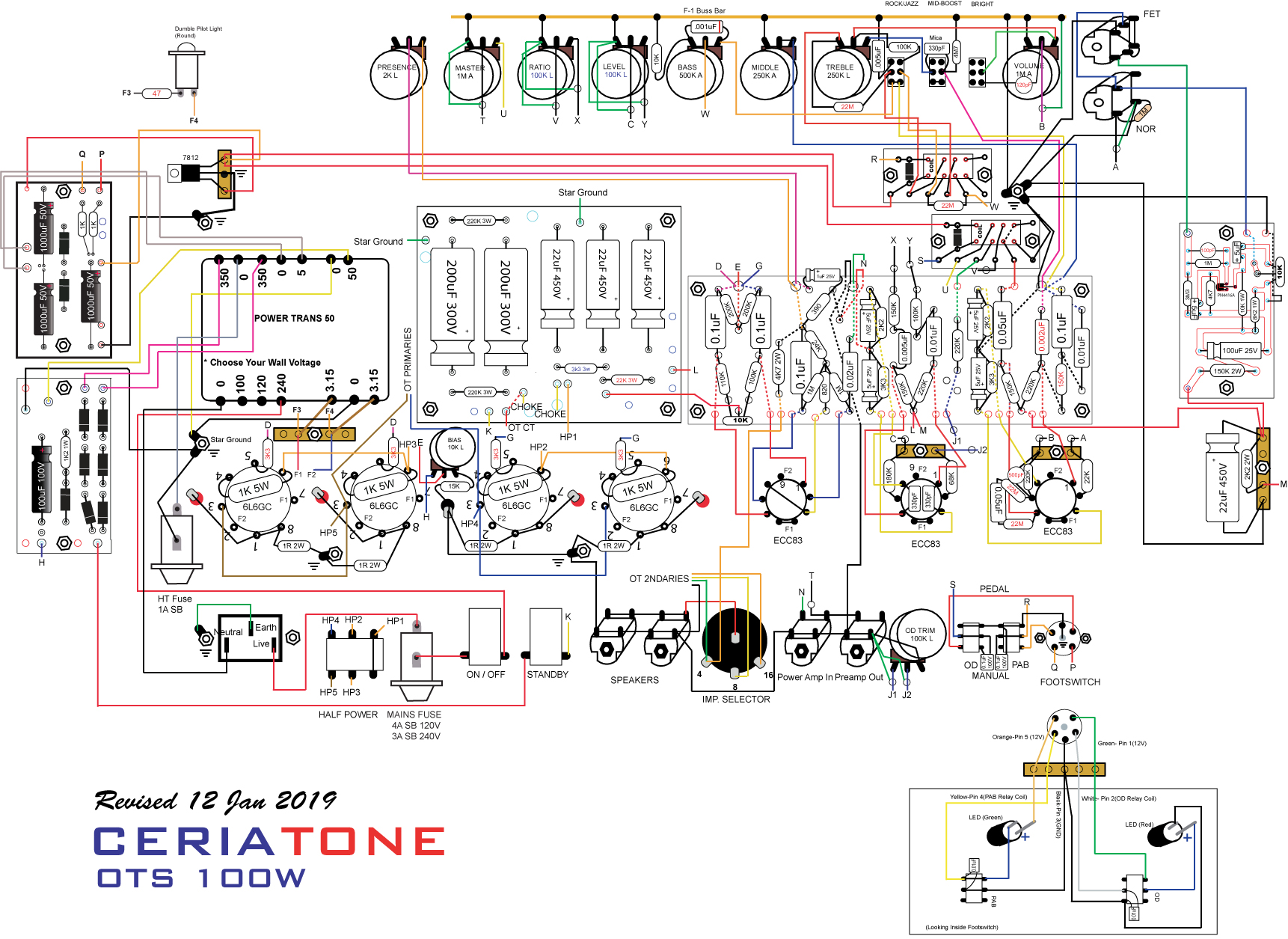
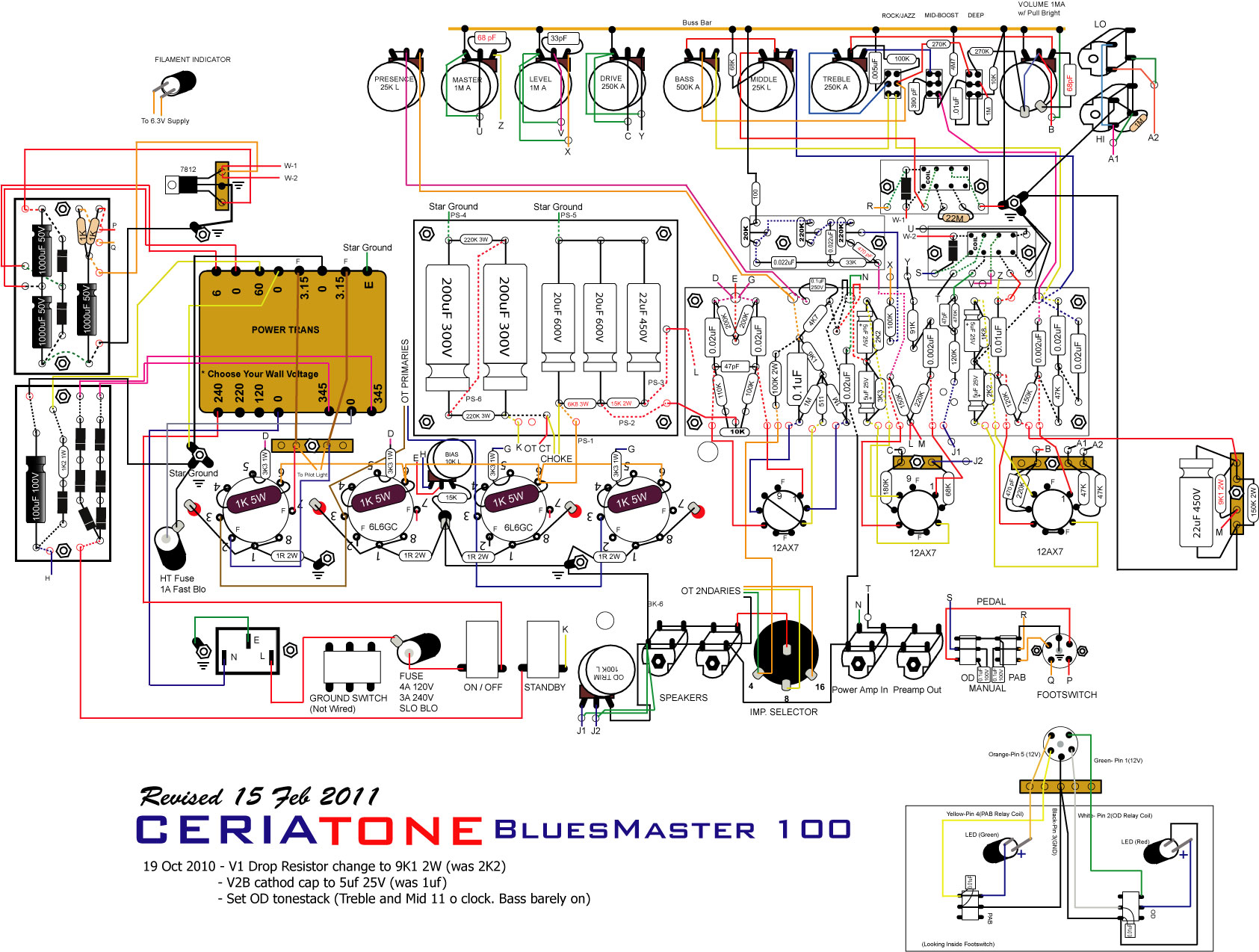
EDIT: comparing them now I would have expected the plate resistors to be more lopsided toward the in-phase side of the PI in the Bluesmaster due to the 9k1 tail as opposed to the 24k tail in the regular OTS above. Also interesting is that they both attempt to eek out a bit more gain than the typical 82k/100k you see in most Fenders and Marshalls.
Early brewers were primarily women, mostly because it was deemed a woman's job. Mesopotamian men, of some 3,800 years ago, were obviously complete assclowns and had yet to realize the pleasure of brewing beer.
-
martin manning
- Posts: 14936
- Joined: Sun Jul 06, 2008 12:43 am
- Location: 39°06' N 84°30' W
1 others liked this
Re: Dumble Push-Pull power amps: what really matters?
I recall numerous comments on TAG saying that ODS with Twin Reverb OT (single 4 ohm secondary) were often operated using an 8 ohm speaker load.